What Is a Neuron?
Meet the nervous system’s signaling cell—and the remarkable structure that helps it receive, process, and share information.
Last updated
A cell built for communication
A neuron is a cell specialized for receiving, processing, and transmitting information. When you recognize a familiar voice or reach for a cup, networks of neurons help make that possible. A single neuron is one participant in a much larger conversation—not a tiny brain working alone.
Neurons use changes in electrical voltage and, at many connections, chemical messengers to influence other cells. Their distinctive shapes help them connect with particular partners. Understanding that relationship between structure and function is a useful first step into neuroscience.[1]
The main parts of a neuron
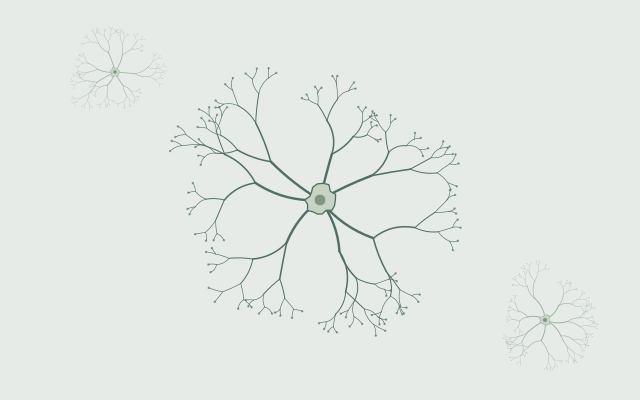
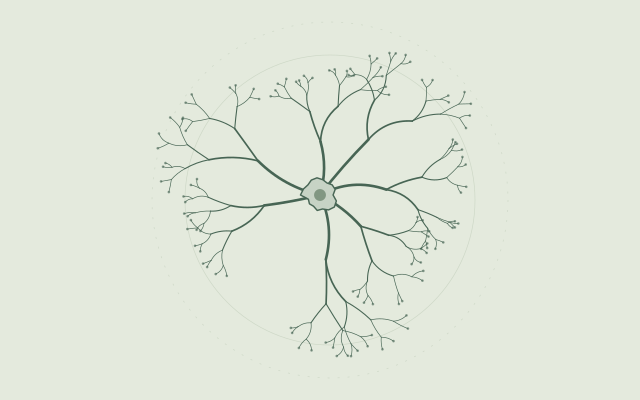
Many introductory diagrams show a multipolar neuron, with branching dendrites, a cell body, and one axon. This is a helpful model, although real neurons come in many forms.
- Dendrites are extensions that receive many of the cell’s inputs. Some have small protrusions called dendritic spines, which can host synaptic connections.
- The cell body, or soma, contains the nucleus and much of the machinery needed to maintain the cell. It also receives inputs.
- The axon is an extension that carries signals toward other cells. Its branches can reach several targets.
- Axon terminals are specialized endings that communicate with target cells at junctions called synapses.[2]
These labels describe regions of one continuous cell. The axon is not a separate wire attached to the soma, and the dendrites are living, active parts of the neuron.
From an input to an output
At a chemical synapse, a presynaptic cell releases a neurotransmitter. The transmitter can bind receptors on a postsynaptic cell and change its activity. Some inputs increase the likelihood that a neuron will fire; others decrease it. The effect depends on the receptors and cellular conditions, rather than on a simple label attached to a signal.
Inputs interact across space and time. If conditions at the neuron’s spike initiation region reach threshold, an action potential can begin. This brief electrical event propagates along the axon. At many axon terminals, its arrival helps trigger neurotransmitter release, continuing the conversation.[3]
A useful starting picture: dendrites receive, the cell integrates, and the axon carries an output. Treat this as a guide, rather than a rule without exceptions.
Neurons do not work alone
Neurons depend on neighboring glial cells. Astrocytes help regulate the local environment. Oligodendrocytes produce myelin around some axons in the central nervous system, while Schwann cells do so in the peripheral nervous system. Microglia contribute to immune surveillance and tissue maintenance.[1]
Different neurons also have different jobs. Sensory neurons convey information about the world and body; motor neurons influence muscles; other neurons connect and transform activity within circuits. What a neuron contributes depends on its connections as well as its individual properties.
Key takeaways
- A neuron is a living cell specialized for communication.
- Dendrites, soma, axon, and terminals support different parts of that process.
- Electrical and chemical signaling link neurons into circuits.
- Glia and other cells are essential partners in nervous system function.
References
- OpenStax. Anatomy and Physiology 2e, 12.2: Nervous Tissue.
- Waymire, J. C. Neuroscience Online, Chapter 8: Organization of Cell Types. McGovern Medical School at UTHealth Houston.
- Purves, D., et al., editors. Neuroscience, 2nd edition (2001). Neural Signaling. NCBI Bookshelf.
Demonstration lesson: the author must review the explanation and references before final publication.